
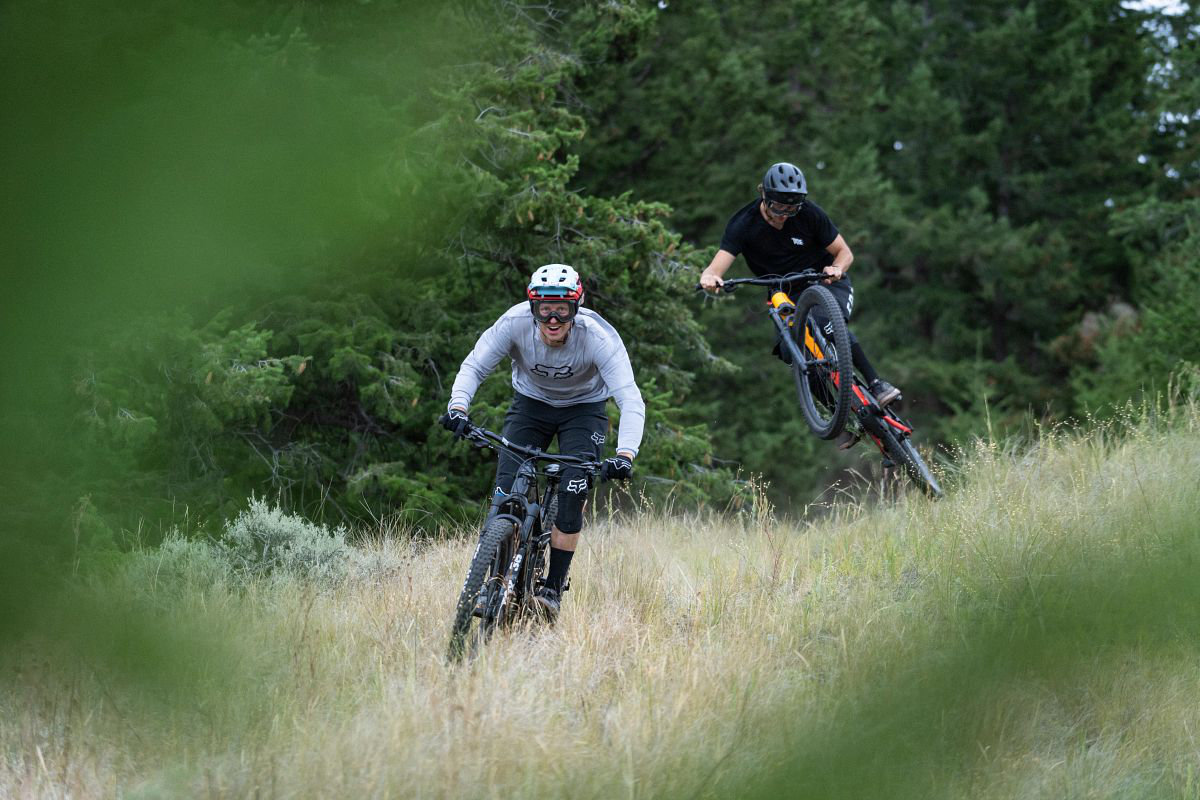
Who would win: The fast and agile lightweight or the big hitting heavyweight?
What matters most: POWER or PRECISION?
It’s a classic debate found in pubs, workplaces and school yards across the country. So we decided to review two of Trek’s top electric mountain bikes, one falling into each camp – first up the heavyweight… the big power, hard-hitting Trek Rail. The challenger, the lightweight Trek Fuel EXe, the newer, more agile trail bike that Trek called its biggest release in a decade!
Rail and Fuel EXe are two of Trek’s flagship full suspension electric mountain bikes, both worthy of consideration and both with real strengths, but which should win the fight for your hard-earned cash? What are the differences, and which is right for you?
First let’s check out the Trek Rail, weighing in at around 24KG, it’s the monster truck of e-bikes
The Trek Rail is hugely popular and continues to be the weapon of choice for those who want epic days shredding on the trails.
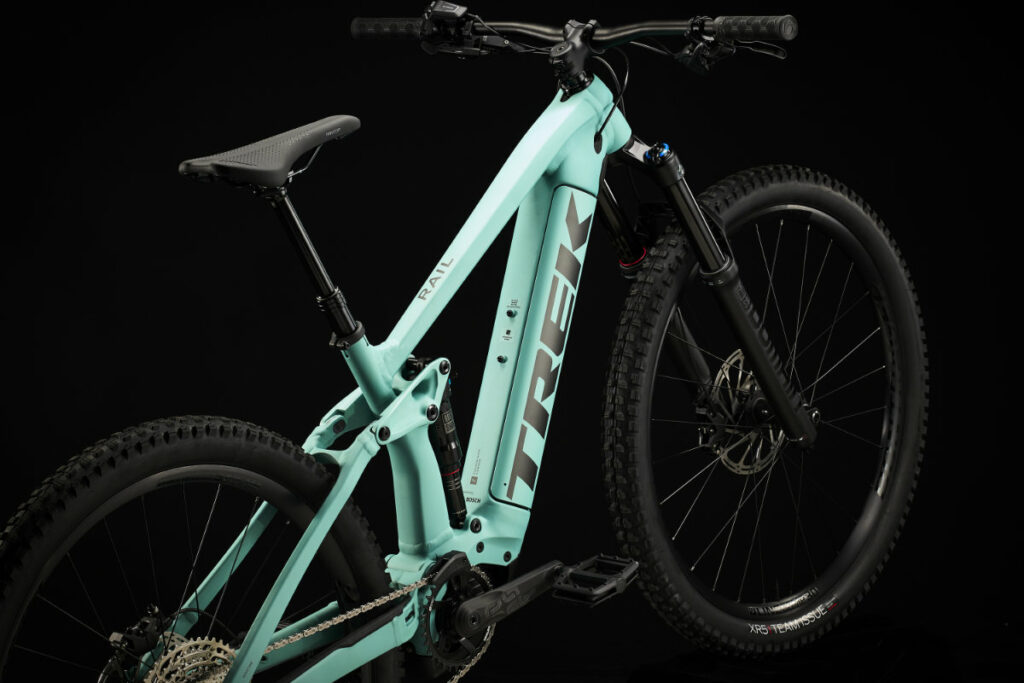
The Trek Rail is a lot of bike. Long travel suspension front and rear, powerful motor, excellent range, chunky tyres… everything about it is big. It instils confidence on technical trails and really looks after you (even where your riding ability could be better!). This is every inch the full fat e-bike; a bike that rolls over everything in its path as though it wasn’t there.
The Trek Fuel EXe really is a lightweight by comparison, coming in at around 19kg depending on spec.
The weight saving is immediately obvious in the look and feel of the Fuel EXe. At a glance, it’s not obvious this is an e-bike at all. The Fuel EXe made a massive impact on the e-bike market when it launched last year, blurring the lines between assisted and “acoustic” rides. It was described in the cycling media as a “game changer” and, having hit the trails on the EXe, we can tell you that it truly is.
The Fuel EXe takes the e-bike concept and turns the dial back a little. It offers just the right amount of assist to help you up the hills and prolong those days in the saddle. The motor is subtle and silent, and the overall experience is of a nimble and sure-footed full suspension bike that’s much closer in feel to riding a standard “acoustic” bike – the EXe is lighter, more playful and will reward more technical riders.
Let’s look in more detail at key areas and how the Trek Fuel EXe and Trek Rail compare.
Power and range – The battery and motor
The Trek Rail is a full-assist e-MTB with a Bosch Performance Line CX motor that provides up to 85 Nm of torque and a battery with 500 to 750 Wh of power, depending on the model. There are four power modes and the range on a full charge is up to six hours, depending on how much assist you’re using. We can tell you that the power equals big speed and bigger smiles. You will race up climbs that previously left you panting and you will fly over rocks and roots as though they were never there. The only thing to be aware of is that sometimes, in a tighter turn, that big power can catch you out – in Turbo mode your own input is multiplied by the motor a lot and you need to be dialled in to stay on your line. The motor does, however, have the new Bosch new smart system for 2023 that anticipates the level of assistance you need, reacting to your input.
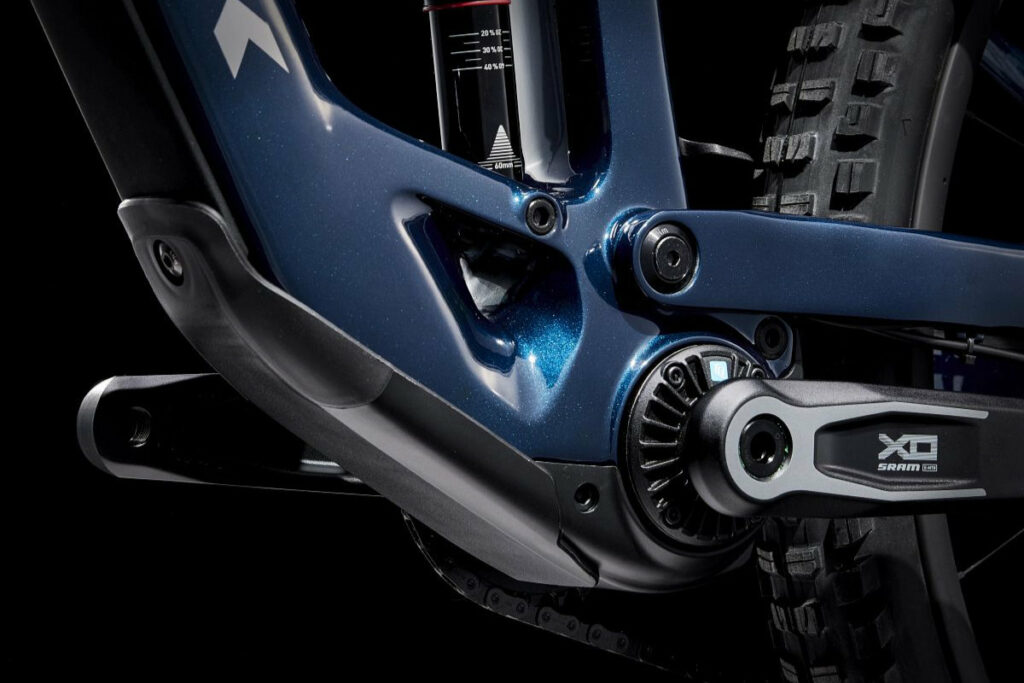
Trek Fuel EXe offers mid-level assistance, replicating the more natural feel of a traditional mountain bike and feeling very much like its analogue older brother, the Fuel EX. It features a TQ harmonic pin ring motor that provides up to 50 Nm of torque and weighs in at only 1.85kg. The 360 Wh battery provides up to five hours of power. There are three modes, so you are only the press of a button away from just the right amount of assistance.
The big thing with the EXe motor is it’s practically silent, so your friends probably won’t know you are riding an e-bike at all and you can enjoy the sounds of the world around you rather than the whir of your motor!
The Ride – Geometry and suspension
Based on Trek’s Slash enduro bike, the Rail has slack geometry and a full suspension set-up with 150mm of rear travel and a 160mm fork. This makes for a bike that soaks up all the trail can throw at it and will see you enjoy maximum control on the steepest, gnarliest descents. The cost of that slacker geometry and big suspension with the analogue Slash is that it can be more of an effort on the climbs, but with that impressive motor on the Rail, it’s just not an issue.
The Fuel EXe is almost identical in look and size to its non e-bike brother the Trek Fuel EX. It’s also a full suspension bike with 140mm on the rear and 150mm on the front. Slightly less travel contributes to lighter weight and a more responsive ride. The geometry of this bike is perfect for most trail centres, and you are going to have to hit the biggest jumps and drops before you reach the limits of its suspension. This bike set up really rewards the accomplished rider who wants to pick their perfect line on a bike that responds fast.
Weight & Feel
When it comes to weight, we have already seen that the Rail is heavier than the Fuel EXe by around 5kg depending on the model and specification. This is due to its larger frame size, bigger motor, battery and extra suspension travel. This extra weight is not a bad thing, in fact it’s hugely confidence inspiring when tackling more technical terrain as it provides a really planted feel, better stability and rolls over almost anything – it really is a monster truck that will make you feel you can take on all you find on your local trails. That said, the planted feel for some leaves a little to be desired, as naturally the bike is a touch less responsive or lively, but this is definitely a bike that delivers the “e-bike smile”… it’s a hoot!
For those looking for whips, jumps and superfast handling, the EXe might just be the one for you.
The Trek Fuel EXe does feel nicely anchored when you’re attacking the descents and pushing it into berms, however this is a bike designed to be lightweight… you will be surprised how easy it is to pick this bike up and put it on your car’s bike rack, and that weight saving translates to a beautifully balanced bike that’s fast turning, flickable and feels just like a non-electric mountain bike – in fact without the power on, we had no difficulty in keeping up with friends on the trails.
Technology
In terms of connectivity, Trek developed a new app called Trek Central for the Fuel EXe, which allows the customisation of assistance levels and other motor parameters. The app also learns from your riding style to estimate how much range you’ve got left in the battery. The display in the top tube gives information on battery life, range and other data.
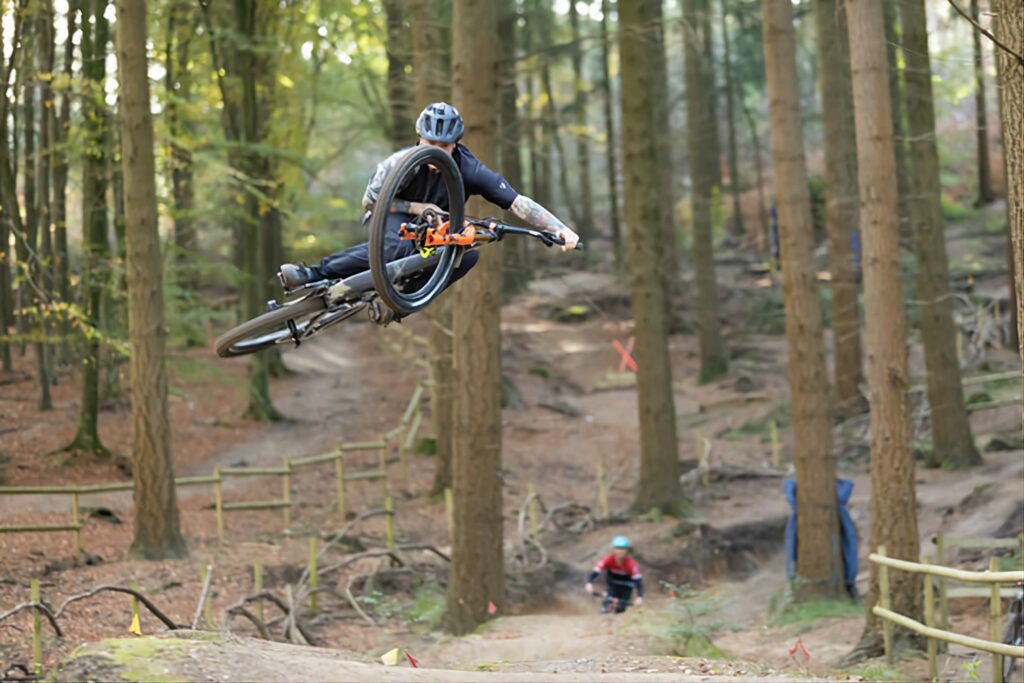
Where’s best to ride Fuel EXe and Rail?
We asked our mechanic Keefer for his three top picks to ride these two fantastic machines: one local, one national and the global dream location.
Local: Rogate Downhill, Essex.
“A friend of mine, John, has a Rail 9.9 and he can do laps and laps of this place. There’s flowy and techy trails at the top and in the bottom half there’s loads of drop and jumps, which is where full sus is more comfortable. E-bikes are also surprisingly springy and well-planted with the extra weight.”
National: Dirt Farm, near Abergavenny, Wales.
“This is our favourite place to ride. It’s just out and out fun. Fast and flowy, with some jumps that hit 40 to 45ft and a great atmosphere as well. No-one looks funny at e-bike riders there. The uplift is actually a tractor and trailer which John can beat on the way up and everyone always cheers when he passes.”
Global: Squamish in British Columbia, Canada.
“This looks a great place to ride. Trails through the woods, long descents, wild single track… it’s just local trails but it looks amazing. E-bikes would be perfect for that as once you get to the bottom, you’ve got to pedal back to the top. There’s nearly 300 trails so you don’t want tired legs stopping your fun.”
Price
The Trek Rail 5 500W Gen 2 starts at £4,600 with the range topping out with the Rail 9.9 XX1 AXS Gen 4 at £12,950 – at this spec you have Trek’s best carbon frame, smooth Rockshox suspension and SRAM’s best wireless electronic drivetrain.
The Fuel EXe is available with a carbon frame only. The Shimano Deore equipped 9.5 is the entry point to the range at £6,400 and the top of the range 9.9 XX1 AXS comes in at £13,500 – a price that will see you on the latest bike with the highest available spec of components and the envy of anyone you meet on the trails.
So which is right for you?
As always, the choice is ultimately about the kind of riding you want to do, your fitness and technical ability.
The Rail will handle pretty much any trail you can throw at it and gives you a lot of confidence on the rough stuff. The full assist powers you up the hills and offers a hefty boost over an extended period of time. You’ll get more miles from the Rail, so you can say goodbye to range anxiety and you are guaranteed to keep up with friends and smile from ear to ear while you do!
Fuel EXe is the gateway bike to e-bikes, delivering a natural riding experience and rewarding skilled riders with its agile handling. It looks, feels and sounds just like an analogue bike but offers just enough assist to keep you riding for longer. You’re still going to get a great workout and have the energy to enjoy what you’re doing. If you value a natural feel and more responsive ride over big power, then this will be the bike for you.
Compare Trek Rail and Fuel EXe for yourself in either our Ashford or Folkestone stores.


